
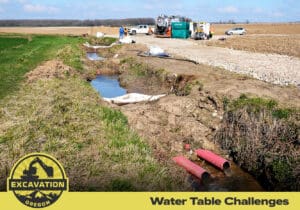
 If your construction project will be in an area with a high water table, you will need to account for this underlying ground condition while planning for excavation and construction. In fact, one of the most important factors to consider is the water table, which can significantly impact commercial excavation, foundational supports, and, ultimately, the project’s budget and timeline. Water table challenges are common in commercial excavation, and our team at Excavation Oregon will ensure that your structure has the best foundation based on its environment. This article will explore the challenges posed by high water tables, the steps necessary to address these issues, and how they translate into the broader scope of project costs and timelines.
What is the Water Table?
The water table is the level below the ground surface where the soil is fully saturated with water. It fluctuates depending on environmental factors like rainfall, snowmelt, and proximity to bodies of water. In regions where the water table is shallow, commercial excavation can become challenging, as the presence of water can destabilize the ground, make digging difficult, and require additional measures for proper foundation support.
The water table level in Southern Oregon can vary significantly depending on the specific location, season, and proximity to natural water sources like rivers, lakes, and wetlands. Southern Oregon generally has a relatively high water table in low-lying areas near rivers and valleys. In contrast, higher elevations and more mountainous regions often have a lower water table.
Key factors affecting the water table level in Southern Oregon include:
- Proximity to Rivers and Lakes: Areas near major rivers such as the Rogue River and Klamath River often have higher water tables due to the abundance of surface water. The same applies to regions around lakes like Upper Klamath Lake.
- Seasonal Fluctuations: The water table tends to be higher during the wet season, typically in winter and early spring when rainfall and snowmelt saturate the ground. In contrast, the water table often drops during the dry summer months due to evaporation and lower precipitation.
- Topography: Lower elevation valleys, such as the Rogue Valley, are more prone to having higher water tables compared to hilly or mountainous areas like the Cascade Range or Siskiyou Mountains, where the ground is more porous and water drains faster.
- Soil and Geology: The type of soil and underlying geology also affect water retention and table levels. For example, areas with clay-heavy soils may retain more water and have higher water tables, while sandy or rocky soils typically have a lower water table due to better drainage.
Water Table Challenges on Commercial Excavation
When excavating a site for commercial construction, the presence of a high water table can complicate the process in several ways:
1. Water Infiltration into the Excavation Site: A high water table means that during excavation, water may seep into the area being dug, making it challenging to maintain a dry workspace. This can cause delays, reduce equipment efficiency, and make it challenging to reach the desired depth without additional measures.
2. Destabilization of Soil: Waterlogged soil becomes less stable, making the excavation site more prone to collapses or cave-ins. The high water content increases erosion risk and can compromise the integrity of trenches and other dug-out areas.
3. Impact on Foundational Integrity: Foundations built in areas with a high water table are more susceptible to water damage, as water can erode materials, cause long-term structural instability, or contribute to shifting foundations.
4. Increase in Dewatering Needs: Dewatering, the process of removing water from an excavation site, is often necessary when dealing with high water tables. However, this process adds complexity and costs to the project, impacting both the budget and timeline.
Solutions for Managing High Water Tables in Commercial Excavation
Addressing the challenges posed by a high water table requires specialized approaches and techniques to ensure the integrity of the excavation and the long-term stability of the building foundation. Some of the common strategies include:
Dewatering Techniques
The most immediate concern when excavating in areas with a high water table is removing excess water. Various dewatering methods can be employed, depending on the extent of the water table’s impact:
- Sump Pumps: One of the simplest forms of dewatering, sump pumps are placed in trenches or pits to pump water out of the excavation site. While this solution is cost-effective, it may not be adequate for large-scale commercial projects with extensive water infiltration.
- Wellpoints: For larger projects, a wellpoint system may be necessary. Wellpoints are small-diameter wells installed around the perimeter of the excavation site. These wells are connected to a pump, continuously drawing water from the ground, maintaining a lower water level, and creating a dry environment.
- Slurry Walls: In cases where groundwater is particularly aggressive, slurry walls (a mixture of soil, water, and cement) can be built around the excavation site to prevent water from entering. This method, while effective, can be more costly and time-intensive to implement.
2. Soil Stabilization
Waterlogged soil is prone to instability, which makes soil stabilization critical when excavating in areas with a high water table. Techniques such as soil compaction, chemical grouting, or the installation of geotextile fabrics can help reinforce the soil and make it more stable for excavation and foundation placement.
- Compaction Grouting: This involves injecting grout into the soil to displace water and compact loose, water-saturated soils. The result is a denser, more stable base for excavation.
- Chemical Grouting: This technique uses chemical solutions injected into the soil to bind loose particles together, thereby creating a more cohesive soil structure that is less likely to collapse or erode under the pressure of water infiltration.
3. Design Modifications
Sometimes, the foundation design may need to be altered to account for high water table conditions. For example, floating foundations or mat foundations can spread the building load over a larger area, thereby reducing the risk of settlement in waterlogged soil.
- Floating Foundation: A floating foundation functions by balancing the weight of the building against the weight of the soil excavated from the ground, including water weight. It’s a complicated process designed by architects to create a stabilized environment with a high water table area.
- Pile Foundations (or Caisson Foundations): For commercial projects requiring deeper foundations, piles can be driven into the ground to transfer the building load to more stable soil or the bedrock beneath the water table. This technique helps bypass waterlogged layers, although it can significantly increase costs.
Budget and Timeline Considerations
The presence of a high water table introduces several additional factors that can impact both the budget and timeline of a commercial excavation project. Here’s are some examples:
1. Increased Labor and Equipment Costs
Dewatering systems, soil stabilization techniques, and specialized foundation designs all require additional labor, materials, and equipment. These costs will vary depending on the severity of the water table issue, but in most cases, they can add significant expenses to the overall project budget.
2. Longer Project Timelines
Managing a high water table also extends the time required to complete excavation and foundation work. The additional steps of dewatering, soil stabilization, and potentially modifying the foundation design can add weeks or even months to the project timeline. These delays must be factored into the overall construction schedule to avoid unexpected overruns.
3. Ongoing Monitoring and Maintenance
Long-term monitoring of groundwater levels may be necessary for projects where the water table remains a persistent challenge. Ongoing maintenance of dewatering systems or foundations built in high water table areas may also be required to prevent future issues.
Excavation Oregon can handle all your water table challenges.
The water table is a critical factor in planning and executing commercial excavation projects and can result in water table challenges you need to manage. Understanding the potential issues that arise from groundwater infiltration, soil instability, and foundation design is essential for accurately budgeting and scheduling your project. At Excavation Oregon, we specialize in assessing water table conditions and implementing the necessary solutions to ensure your excavation project proceeds smoothly, on time, and within budget. With the right approach, the challenges posed by a high water table can be effectively managed, resulting in a successful and stable commercial development. Contact us today for more information and to schedule an estimate.