
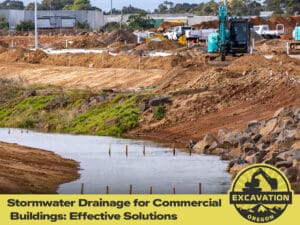
 When it comes to commercial development in Oregon—particularly Southern Oregon—managing stormwater drainage is not just a best practice—it’s essential. Whether preparing a new construction site or maintaining an existing property, effective stormwater drainage for commercial buildings in Oregon helps protect infrastructure, reduce erosion, and comply with local regulations. At Excavation Oregon, our professional excavators and land architects work together to design and implement site-specific drainage systems that address the unique challenges posed by our region’s topography, soil types, and rainfall patterns.l
Before diving into strategies, it’s important to understand the risks posed by poor stormwater drainage:
- Structural Damage: Water pooling around foundations can cause cracking, shifting, or long-term instability.
- Soil Erosion: Improper drainage can lead to topsoil loss and landscape degradation.
- Compliance Issues: Local building codes and environmental regulations often require strict water runoff management.
- Safety Hazards: Standing water can create icy surfaces in winter or slip hazards year-round.
- Mold and Mildew: Prolonged moisture near structures can lead to unhealthy air quality inside buildings.
To prevent these issues, commercial properties need drainage strategies designed by professionals who understand local conditions.
Professional Strategies to Manage Stormwater Drainage for Commercial Buildings
Site Grading and Contour Shaping
One of the most fundamental drainage strategies is site grading, the process of shaping the land surface to control water flow. In Southern Oregon, where terrain can range from flat valleys to rolling foothills, this strategy must be customized for each site.
Professional excavators use laser-guided grading equipment to:
- Create gentle slopes that direct runoff away from structures.
- Establish swales or shallow ditches along property boundaries.
- Design berms to redirect water flow and protect specific zones.
Proper grading ensures that water never accumulates near building foundations or parking lots and instead follows a controlled path toward designated drainage areas.
 French Drains and Subsurface Drainage Systems
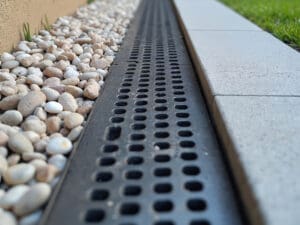 French Drains and Subsurface Drainage Systems
When surface water isn’t the only concern, subsurface drainage systems like French drains provide a discreet and effective solution. French drains consist of a perforated pipe wrapped in gravel and landscape fabric, buried underground to intercept water before it rises to the surface.
French drains are ideal for:
- Parking lot perimeters.
- Foundations of large commercial buildings.
- Landscaped areas prone to saturation.
By collecting and redirecting groundwater, French drains help prevent damage to below-grade structures and maintain usable, dry surfaces even during Southern Oregon’s rainy seasons.
Retention and Detention Basins
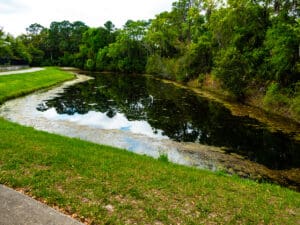 Retention and Detention Basins
Larger commercial developments often incorporate retention or detention basins to manage stormwater runoff. These engineered basins serve different purposes:
- Detention basins temporarily hold runoff and release it slowly to reduce peak flow into municipal systems.
- Retention basins hold water permanently and are typically landscaped to support natural infiltration.
Oregon’s environmental codes often favor systems that mimic natural hydrology, making these basins a common component of stormwater drainage for commercial buildings in Oregon.
These systems are especially important in developments with extensive impervious surfaces like parking lots or warehouses, where water cannot infiltrate the ground naturally.
Permeable Pavement and Hardscape Solutions
To reduce the volume of runoff, commercial properties can integrate permeable pavement systems in sidewalks, driveways, and parking areas. Materials like porous asphalt, permeable concrete, and interlocking pavers allow water to pass through the surface and into an underlying gravel bed where it can slowly infiltrate the soil.
Benefits of permeable hardscapes include:
- Reduced need for storm drains.
- Natural groundwater recharge.
- Decreased heat island effect from paved surfaces.
In addition to pavement, land architects often design bioswales—vegetated ditches that filter and slow runoff—and rain gardens that double as landscape features and infiltration zones.
Culverts and Channelization
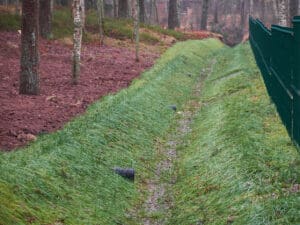 Culverts and Channelization
When water needs to be diverted across or away from a commercial property, culverts and channelized ditches are common solutions. These systems are particularly relevant in Southern Oregon’s hilly regions, where gravity-driven runoff can be intense during heavy rains.
Culverts, typically made from concrete or corrugated steel, are installed under driveways, roads, or parking lot entrances to maintain unimpeded water flow. Channelized ditches may be lined with rock (riprap) or concrete to prevent erosion and direct water into safe outflow areas.
Proper sizing and placement of culverts are critical to preventing backflow or washouts, which is why professional engineering and installation are essential.
Erosion Control and Vegetative Solutions
Controlling erosion is a major focus for commercial properties built near slopes, rivers, or undeveloped land. Professional excavators and landscape architects use a combination of mechanical and natural solutions, including:
- Silt fences to catch sediment during construction.
- Straw wattles or coir logs on slopes to slow water flow.
- Hydroseeding or native grass planting to stabilize disturbed soil.
- Geotextile fabrics beneath gravel to support long-term stability.
These techniques are especially important for properties in rural or transitional zones common in Southern Oregon, where protecting the surrounding environment is both a regulatory and ethical concern.
Integration with Municipal Stormwater Systems
In urbanized areas like Medford, Grants Pass, or Ashland, drainage strategies must account for existing municipal infrastructure. This often involves:
- Connecting site drains to public storm sewers with proper permits.
- Installing oil-water separators to clean runoff from parking areas.
- Using flow restrictors to prevent overwhelming the city system.
Professional excavators ensure that all connections meet code requirements and are positioned to handle peak flows, protecting both the client’s property and the broader community.
Partner with Excavation Oregon for Reliable Stormwater Drainage
Stormwater drainage for commercial buildings in Oregon is a critical component of every site’s design and long-term success. In Southern Oregon, the combination of seasonal rain, diverse topography, and growing development makes it essential to choose a professional excavation partner who understands both engineering principles and local regulations.
No two commercial properties are alike. That’s why Excavation Oregon begins every project with a thorough site evaluation that includes:
- Soil composition testing to determine infiltration capacity.
- Topographic surveys to understand flow paths.
- Regulatory assessments to ensure code compliance.
For instance, clay-heavy soils common in certain Southern Oregon regions don’t absorb water as quickly, requiring more emphasis on surface drainage and detention basins. In contrast, sandy soils near river corridors might allow for more aggressive infiltration systems.
At Excavation Oregon, we specialize in custom water drainage solutions tailored to the unique challenges of Oregon’s commercial landscapes. Whether planning new construction or upgrading an existing site, our team will ensure your property stays dry, compliant, and protected for decades to come.
Contact Excavation Oregon today to schedule a site evaluation and learn how we can help you implement a drainage strategy that works.